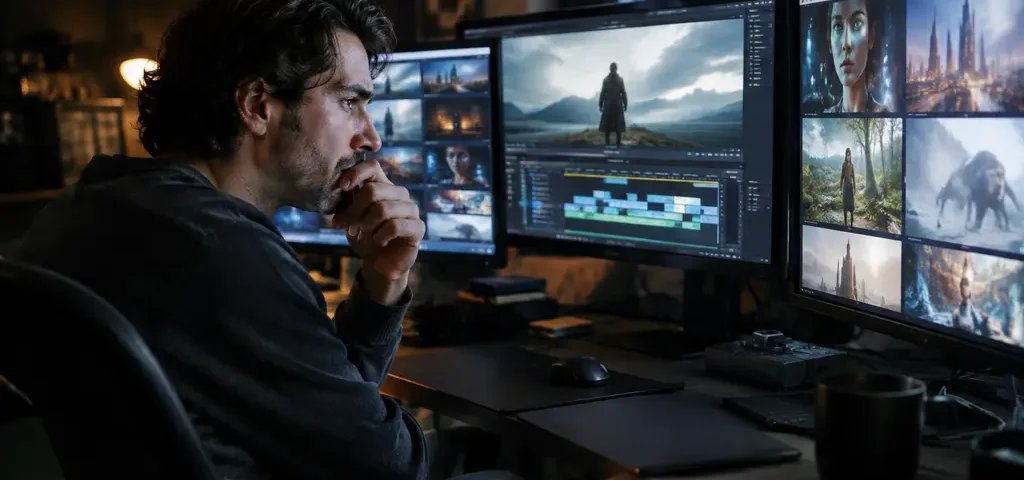
Confirmed: AI in filmmaking has moved from a visible novelty to a quieter production practice across Hollywood workflows. The supplied research points to uses in VFX and visual development, script breakdowns, budgeting, post-production, dubbing, marketing, and distribution. Market-analysis: that matters because the ethical debate is no longer limited to a few experimental shots or promotional clips. It now sits inside ordinary production choices that many viewers may never notice, including background cleanup, de-aging, voice recreation, and workflow automation.
Why AI in Filmmaking Is Hard To See
What AI in Filmmaking Changes For Viewers
Confirmed: the supplied research cites a 2026 survey of studio executives reporting that AI tools were planned for use across an average of 32% of projects in 2026 slates, up from 29% in 2025. Market-analysis: even if that figure is treated cautiously, the direction of travel is clear within the research set. The most anticipated uses were not mainly full synthetic actors or fully generated features. They were VFX and visual development, pre-production tasks such as script breakdowns and budgeting, and post-production workflows.
Opinion: this subtlety is part of the cultural problem. Viewers can debate an obviously artificial image, but they have less opportunity to assess a cleaned-up frame, a partially automated rotoscope, a synthetic background extension, or an AI-assisted dub if credits do not explain the tools involved. The phrase AI in filmmaking can suggest a single technology, yet the examples in the research describe a set of smaller interventions spread across many departments.
Why Disclosure Is Becoming An Audience Issue
Reviewed: the research notes that some mainstream uses of AI have not been clearly disclosed in conventional credits, including forms of cleanup, de-aging, voice recreation, and background work. Confirmed within the research: Everything Everywhere All at Once from 2022 is cited as an example involving Runway AI for cleanup and rotoscoping, while the broader point is that credits often do not identify such tools in a way general audiences can read easily.
Market-analysis: credit disclosure may sound like an industry concern, but it also shapes audience trust. Film and television ask viewers to accept illusion. The ethical question is not whether illusion itself is illegitimate; cinema has always used editing, prosthetics, animation, digital doubles, matte work, ADR, and compositing. The question is whether audiences, performers, and crews receive enough information to understand where human performance ends, where automated assistance begins, and who gave consent for the source material used.
AI in Filmmaking Ethics And Likeness
Confirmed Claims Versus Allegations
Confirmed: on May 7, 2026, actress Q’orianka Kilcher filed a lawsuit against James Cameron, Disney, and associated companies. The suit claimed that her face at age 14 was used without consent as the basis for Neytiri’s face in Avatar, through photographs and facial extraction tools distributed across VFX vendors, according to Variety’s report. Caution: these are allegations in a legal filing, not findings of fact in the supplied research.
Opinion: the case illustrates why likeness questions carry more cultural weight than ordinary tool adoption. A camera records a face, but a face also carries identity, age, labor, biography, and public recognition. If a performer’s likeness can be converted into reusable production data, the industry needs clear consent boundaries. Those boundaries become even sharper when the person was a minor at the time of the alleged source imagery, as the lawsuit claims.
Why Consent Cannot Be Treated As A Technical Detail
Market-analysis: for audiences, AI in filmmaking raises two linked concerns. First, did the person whose voice, face, movement, or prior performance informed the result agree to that use? Second, did the credited artists retain meaningful creative agency over the finished work? A film can use advanced tools and still respect actors, writers, editors, designers, and VFX artists. The ethical failure appears when automation makes consent harder to trace or credit harder to allocate.
Reviewed: the supplied research also notes that in February 2026, multiple studios including Netflix, Warner Bros., Disney, and Paramount publicly criticized a ByteDance AI video platform after fake videos involving stars and alternate finales circulated. Confirmed within the research: that episode was framed as a rights and misuse concern. Opinion: the audience issue is not only deception, but also fatigue. If viewers cannot tell whether a scene, performance, or promotional clip is authorized, trust in official media may weaken.
Labor, Credit, And Audience Trust
Where Automation Meets Creative Work
Confirmed: the supplied research says major studios were hiring AI talent in 2026 for in-house workflows across VFX, animation, sound and dubbing, distribution, and marketing. Market-analysis: these are not peripheral departments. They are the areas where images are finalized, voices are localized, campaigns are tested, and release strategies are shaped. That helps explain why labor groups have focused on synthetic performances and notice requirements rather than treating AI as a distant issue.
Confirmed within the research: studios were under pressure from SAG-AFTRA through a contract ratified in June 2026, including notice obligations if AI-generated performances were used. Caution: the research summary does not provide the full contract language, so any interpretation should remain limited. Opinion: notice is a starting point, not a complete ethical answer. It can inform a union or performer that a synthetic performance is involved, but broader questions remain about compensation, approval rights, reuse, and public credit.
How Awards Culture May Respond
Opinion: awards bodies and festivals will likely face pressure to define how AI-assisted work should be credited, submitted, and evaluated. A visual effects award already recognizes collective technical artistry, but AI-assisted processes may blur whether the primary achievement lies in human design, model output, source material, editing judgment, or all of them together. Reviewed: that question also reaches documentary, animation, dubbing, and performance categories, where authenticity and consent are central to audience interpretation.
Market-analysis: recognition in the creative sector depends on attribution. If an actor’s performance is altered, if an editor uses AI-assisted cleanup, or if a dubbing team works with synthetic voice tools, the public record should not erase the humans who made the final choices. Awards do more than hand out prizes. They create a memory of who made a work and why it mattered. That memory becomes weaker if production credits treat significant AI use as invisible infrastructure.
- Confirmed: the supplied research identifies VFX, pre-production, post-production, dubbing, and marketing as major AI-use areas.
- Market-analysis: each area involves different ethical stakes, from likeness consent to labor displacement to audience disclosure.
- Opinion: clearer credits would help viewers assess craft without requiring trade knowledge.
Courts, Contracts, And The Limits Of Consent

Deepfake Law Is Growing Unevenly
Confirmed: legal regulation around synthetic media has expanded, but it remains uneven. As of mid-2025, about 47 U.S. states had enacted laws related to deepfakes, with definitions and penalties varying significantly; some states treated non-consensual deepfake content as a misdemeanor, while others classified some offenses as felonies with penalties up to 30 years, according to the federal courts’ Evidence Rules agenda book.
Market-analysis: this unevenness matters for Hollywood because production, post-production, marketing, and distribution can involve vendors and audiences across jurisdictions. A studio may centralize policy, but misuse can occur through fan edits, platform tools, overseas vendors, third-party promotion, or unauthorized model training. A legal system built state by state may struggle to give artists and viewers one clear standard.
Why Legal Permission Is Not The Whole Ethical Test
Opinion: law can define minimum obligations, but culture often asks for more. A studio might comply with a notice rule and still leave audiences uncertain about whether a performance was meaningfully human, synthetic, or hybrid. A platform might remove illegal deepfake content and still contribute to a culture in which famous and unknown faces are treated as raw material. Ethical evaluation needs consent, credit, security, context, and a readable public record.
Reviewed: the supplied research states that the 2025 federal TAKE IT DOWN Act criminalized non-consensual publication of AI-generated deepfake pornography, and that two individuals were charged on May 20, 2026, under that law for posting hundreds of AI-deepfake albums depicting 90 different female victims. Caution: that case is outside ordinary film production, but it shows how likeness abuse can move from entertainment debate into personal harm.
Market-analysis: readers interested in the wider relationship between technical systems, accountability, and public safety can explore more on this topic by visiting Pilot Pointer, which covers the interconnections between technology and these issues across various sectors. The shared issue is not the same technology, but the need for clear responsibility when automated tools affect real people.
AI in Filmmaking After 2026’s Warning Signs
Small Uses Still Carry Large Cultural Stakes
Confirmed within the research: director Danny Boyle stated in September 2026 that he used around 30 seconds of generative AI in Ink, a Netflix project, and disclosed that use in the film’s credits. Market-analysis: that example is useful because the amount of screen time was small, yet the disclosure carried symbolic value. It treated viewers as people entitled to know something about how the image was made.
Opinion: AI in filmmaking should not be judged only by how many seconds appear on screen. A brief synthetic insert may raise fewer concerns than a full unauthorized performance, but a short scene can still rely on training data, likeness references, or labor decisions that deserve scrutiny. The better question is not whether AI is present, but what it touched: a face, a voice, a script analysis, a marketing prediction, a background plate, or an editorial fix.
A Practical Standard For Recognition
Opinion: recognition in film should adapt without panic. Awards, studios, guilds, and festivals could treat AI disclosure as part of craft reporting rather than as an automatic mark against a work. A production that identifies AI-assisted visual cleanup, credited human supervisors, consent terms, and affected departments gives audiences more information than one that hides comparable work behind generic technical language.
Market-analysis: the most durable ethical standard may be plain documentation. Who approved the use? Whose material was used? Which department controlled the output? Was a performer’s likeness, voice, or prior work involved? Did the credited artists have final judgment? Those questions protect more than legal interests. They protect the relationship between audiences and the people whose labor makes screen culture possible.
Reviewed: the 2026 research record does not prove that AI has replaced Hollywood creativity. It shows a quieter pattern: AI tools are being inserted into ordinary production tasks while law, contracts, credits, and audience expectations try to catch up. That is why the debate over AI in filmmaking is best treated as a question of recognition. The creative sector depends on knowing whose choices, risks, performances, and images are being honored. If AI use remains hidden, that recognition becomes harder to trust.