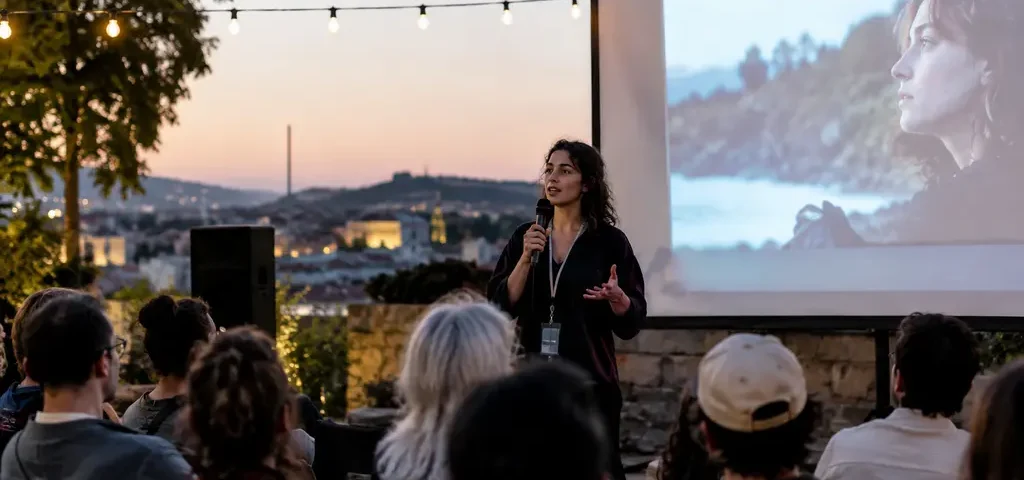
Confirmed: independent voices became more visible across 2026 festival culture because production activity, audience behavior, and community programming all moved in the same direction. The revival should not be overstated as a complete recovery for every filmmaker or city. Los Angeles County still faced declines in shoot days during the second quarter of 2026, while some growth appeared stronger in other production centers. Yet the available evidence points to a meaningful shift: lower-budget features expanded in 2025, Sundance’s 2025 attendance rose, and several 2026 festival events placed regional, diverse, and community-based storytelling near the center of their public identity.
Independent Voices And The Production Rebound
Independent Voices And Lower-Budget Growth
Confirmed: the 2026 Industry Outlook Report recorded 829 feature films beginning production in 2025, a 19% increase from 2024, with growth concentrated in lower-budget projects. Films budgeted under $40 million increased 24% in number in 2025 compared with 2024, according to the same industry report 2026 Industry Outlook Report. Market analysis: that matters for festivals because lower-budget growth tends to widen the pool of work seeking discovery outside franchise-driven theatrical channels.
Confirmed: in the $1 million to $5 million budget tier, estimated spending rose from about $880 million in 2024 to $1.22 billion in 2025, driven by a 46% rise in project count. Market analysis: this tier is especially relevant to festival programmers because it can support professional craft while still leaving room for stories that do not depend on broad commercial pre-awareness. That combination has long made festivals a first point of contact between artists and audiences.
Spending Shifted Toward The Middle Tier
Market analysis: the revival of independent voices should be read less as a sudden artistic awakening and more as a production reallocation after a difficult financing period. When the middle and lower tiers expand, festivals receive more films that are built around voice, community, form, or subject rather than brand extension. That does not guarantee quality. It does create more chances for selection committees, critics, distributors, and local audiences to encounter work that might otherwise remain outside public circulation.
Confirmed: production conditions remained uneven. New York’s second quarter of 2026 saw production spending climb 57% year over year to nearly $1.06 billion, with the number of projects shooting up 19%. By contrast, Los Angeles County recorded a 20% year-over-year decline in feature shoot days in the second quarter, while TV production shoot days fell 30%. Market analysis: these figures suggest a revival with pressure points rather than a uniform boom. The cultural question is not simply how much production returned, but where production returned and which filmmakers gained access to that return.
What Festival Attendance And Ticket Data Show
Sundance Attendance As A Confirmed Signal
Confirmed: the 2025 Sundance Film Festival attracted 85,472 in-person attendees, a 17% increase over its 2024 attendance, according to the Associated Press Sundance attendance report. Market analysis: that rise supports the idea that audiences did not abandon festival-going after pandemic-era disruptions. Instead, attendance gains at a major independent-film institution suggest that in-person discovery still carries cultural value, particularly when the event is tied to filmmaker access, public conversation, and a sense of shared discovery.
Opinion: this is where the festival model retains an advantage over isolated streaming discovery. A film watched alone can still move a viewer, but a festival screening creates a temporary public. That audience may include local residents, critics, distributors, programmers, students, filmmakers, and viewers who chose the screening because the festival framed it as worthy of attention. For independent voices, that framing can be the difference between a film being available and a film being discussed.
Festival Revenue And Community Demand
Confirmed: at IND/EX 2026, held June 22–25, 2026, in Chicago, Eventive data showed average indie film ticket revenue exceeding $13 per ticket, while capacity utilization for indie festival screenings stayed well above pre-pandemic levels in the mid-50% range. Market analysis: these figures suggest that at least part of the audience is willing to pay for curated theatrical access, not only for prestige premieres but for the social setting around independent exhibition.
Reviewed: this pattern also fits recent festival coverage on this site, including reporting on how AFI FEST indie voices pointed toward discovery titles and global programming as meaningful parts of festival identity. The connection is not that every festival now works the same way. Rather, several 2026 examples indicate that festivals are using curation, audience awards, regional identity, and filmmaker presence to create value that cannot be reduced to simple content supply.
Community Programming After The Financing Freeze
Harlem And Durham As Local Signals
Confirmed: Voices Rising Film Festival in Harlem was scheduled for Sunday, November 8, 2026, from 2:00 p.m. to 7:00 p.m. local time, with eleven films focused on independent cinema and diverse storytelling. Because that date had not yet occurred as of October 31, 2026, it should be treated as an upcoming event rather than a completed example. Market analysis: its scale matters. A compact program can function as a community gathering and a discovery platform without needing the size or market activity of a major festival.
Confirmed: Hayti Heritage Film Festival returned March 4–7, 2026, after a year off, under new curatorial leadership. Its lineup mixed classics, emerging independent work, and community-centered films. Opinion: that blend is culturally significant because it refuses to treat new independent cinema as detached from memory, place, or older film traditions. A community-based festival can connect emerging work with audiences who bring local knowledge and historical context into the room.
Audience Engagement Beyond The Premiere
Market analysis: festivals are often discussed through premieres, acquisition deals, or awards. Those markers still matter, but the 2026 revival is also about repeat contact between films and communities. A screening can start a conversation about neighborhood change, identity, labor, migration, genre, faith, family, or creative survival. For readers tracking audience behavior across film, television, and unscripted culture, related coverage at True Real TV illustrates how community response increasingly shapes the meaning of screen media beyond the initial release moment.
Opinion: the most useful festival guide for 2026 is not just a calendar. It should ask what kind of cultural work an event performs. Does it give local audiences access to films they would not otherwise see theatrically? Does it pair screenings with discussion? Does it make room for newer filmmakers alongside established names? Does it document attendance or audience response in ways that help independent film remain visible after the event closes?
Why Independent Film Recovery Remains Uneven
Production Growth Does Not End Access Problems
Confirmed: the research record shows growth in feature production and selected spending categories, but it also shows regional stress. Los Angeles County’s second-quarter decline in feature and TV shoot days indicates that many workers and smaller productions still faced a tight market in 2026. Market analysis: this matters because a revival measured only by project count can miss the labor conditions behind the films. A festival may show more new work while the people making that work still face unstable financing, location shifts, and limited distribution options.
Opinion: the strongest independent-film culture will likely depend on more than premieres. It needs venues willing to program smaller films, festivals willing to maintain discovery sections, press willing to cover work without celebrity hooks, and audiences willing to treat local screenings as cultural participation rather than passive consumption. None of those elements is guaranteed by a production rebound alone.
Revival Of Independent Voices In Film Festivals
Market analysis: the revival of independent voices in film festivals in 2026 is best understood as a cautious cultural shift, not a settled victory. The confirmed data points are encouraging: more feature production in 2025, stronger lower-budget activity, increased Sundance attendance in 2025, record indie ticket revenue reported at IND/EX 2026, and community-driven programs in Harlem and Durham. Taken together, they show a renewed appetite for films made outside the most expensive production lanes.
Opinion: the lasting value of this revival will depend on whether attention turns into durable support. Festivals can introduce audiences to new filmmakers, but they cannot solve financing, distribution, or regional production stress by themselves. Their cultural power lies in making films public: placing them before audiences, naming them as part of a shared conversation, and giving smaller works a chance to be encountered with seriousness. In 2026, that public function became more visible again.